my steps up to my room, dazed and a little disappointed because I was hungry, and, with determination to prove the mensa lady wrong, I rechecked the time on my cell-phone, which had definitely woken me at 7:30. My Italian cell-phone/alarm clock had not picked up on any time change; it was clearly 8. The world felt a little weird as I stood there rereading the time, wondering what I had done wrong or if I had heard the mensa lady, or mensatista(?), incorrectly. Knowing I was not going to get breakfast until the mensa lady wanted to give it to me, I sat down and checked my computer in the dark (Caylen my roommate did not have plans this early in the morning). My computer said it; we had gained an hour and it was only 7 o'clock. Annoyed to discover that I could have slept longer, I waited half an hour for breakfast to open, then walked back down to la mensa and ate until it was finally time to catch the 8:20 vaporetto to Venice. Eerily, Maria, Lizzie, and Dane were not at the vaporetto stop. The quiet vaporetto ride over felt slightly strange. I began to wonder whether my group had decided not to go with me; more importantly, I hoped I would be able to find the morning mass alone. When I eventually walked into Saint Marc's basilica and found Maria, Lizzie, and Dane sitting in a row of folding chairs across the warped mosaic floor at the end of the 8 o'clock mass, I realized that they still thought 7 was 8. I was late, in a way, to my group mass, because I was the only one who had happened to run into the time change.
A time change. For some reason I had not imagined Europe as having time changes. If you think about the romantic "gaze," I suppose you could say that I had assumed a sort of romantic timelessness about Europe and that I had been unintentionally gazing at its plentiful historical markers as signs of its constancy or even vacancy of tempo. Foolish,
 I know. It isn't as if I was aware of myself gazing at things this way, but when I felt surprised to wake up with an extra hour, I was surprised not only because I ended up sitting through the 9 o'clock mass alone after Maria, Lizzie, and Dane had gone, but also because the effect of the change had finally upset my hidden appreciation for the undisturbed, persistent age of Europe that actually does not exist. It is obvious to me now that Europe's time has been "interrupted" by modernity, even so directly as the very rewinding or speeding up of time itself. Today was the day it hit me that the new is equal to the old here, and even in places where the old is buried beneath itself, such as in Venice, the new is still equally as deep. As tourists, I think we often forget this in our search for the gaze (for definition sake, the "gaze" is a term used by John Urry in one of my class readings; it is the act of a tourist looking at something and seeing what may not be there; Urry says: "It is... gaze which gives a particular heightening to other elements
  of (an) experience, particularly to the sensual"). Tourism is almost foolish in its use of this gaze effect to entertain. We hope to find a place that has qualities we find exceptionally different or desirable, but it is often in our heads. The everyday tourist's experience is largely the imagination running wild in the reality of scenery. For one thing, we look upon a place rather than touch it; we travel in safety, we gaze. As travelers we are moving through, not stopping to be affected, and our gazes are mostly set in our imaginations simply because we do not interact with these places. Needless to say, this gaze is present in Venice, just as it was when some of my gaze crumbled earlier today. The strange circumstance of the tourist's gaze in Venice is its dominance, though; more people in the city think the city old than new. In various ways, gazes such as mine own this city, controlling its economy by giving or withdrawing tourism, controlling its appearance by instructing Venice through economical pressures, and controlling the culture by overrunning its people spatially and commercially. Where does this put the Venetian resident? And, as gazes are broken, what or who is the Venice revealed?
After a long and beautiful service in Saint Marc's basilica, full of magnificent songs and all in Italian, I turned and walked out into Piazza San Marco like a "true" Venetian. I had not been inside the basilica just to adore its beauty, not to say I didn't do that while in there, but I had been there to worship, to use it for the purpose it was built to serve (which includes adoring its beauty, ironically). I had stood, I had sat down, I had understood some of the sermon because I know a little Italian and I know the general purpose of sermons, and I had even prayed, something I have not done in a while (at least not since sleeping in that haunted-I-swear guest room in my new house in Cleveland). In the midst of it, too, I had actively performed a "gaze" upon myself to try and put a "Venetian" where I really saw me attempting to understand an Italian, Catholic mass. I then realized that unlike the everyday tourist I had dropped my gaze. With the new respect for the present in Europe that the time change had invoked in me, I was engaged in the present, and when I walked out of the basilica afterwards, I walked out without a gaze. The Piazza seemed alive to me, even while stifled by tourists. I noticed the people who rely on the Piazza as a structural rather than ornamental feature in their lives: the souvenir vendors, the waiters at the cafes, the musicians, the tour guides, the artists, the sweepers, and any other Piazza regulars. Life is survival, and these people bring the closest form of that to this touristic territory.
Walking back to the S. Zaccaria vaporetto stop and ignoring a painfully tight right leather shoe, I realized that I had 30 minutes until the ride back to San Servolo and decided to follow the lagoon east to find out what was happening up and down and between the bridges lining the front of the city. Gaze-less, so the speak,
 I was simply interested in what people were doing at the moment, why there was a path blocked off and guarded all the way down the front of Venice. Following the ramps that traversed the bridges parallel to the lagoon, I finally came to a finish line where a scattered number of people sat in temporary, metal stands watching runners and bikers on a giant screen making their way from Stra, a town 25 km west of Venice. It was the finish line of the "Venice Marathon," an annual event in which athletes from around the world compete for a small cash prize and, I am sure, simply to end up in Venice. People were watching the race on the giant screen across from the stands because none of the
  competitors had made their way to Venice yet, but people were already waiting for their arrival. A man on a loud speaker was commentating on the progress of the race. The man's amplified voice was deafening yet as the only sign of true excitement around this early in the race it was a fitting tribute to the excitement to come and the current exertion of the runners. By this point in my walk, my right foot was killing me, so I waddled over to the stands and sat down to watch, grabbing a free Yakult sample on my way over. Yakult is yummy stuff. It's a sort of yogurt drink with a sharp strawberry flavor that you can drink on the go, almost like pleasant tasting Slim-Fast. Unfortunately, I had to catch the vaporetto before the runners
  arrived, although once on the boat I did get to see some recumbent cyclists, the ones that lay against the ground, roll in over the bridges. When I returned to the city after lunch, though, I saw hundreds of runners following a path over from the mainland, along the outside of Venice proper, and across the Grand Canal to the finish line. Police officers, or "polizie," stood along the route ushering regular pedestrians across the running path, and I crossed it, taking a brief look in both directions, feeling like I was really partaking in the commotion. As I watched person after person slowly jog along the pathway, cheered on and clapped for by people outside the ropes, I felt a lot
  of respect for the self discipline of the runners. A long time ago running long distances was sometimes a necessity, and was, as Foucault might agree, more of a "panoptic" activity in which endurance was practiced because society needed it and might or might not have rebuked failure, but today people usually run for their own reasons and enjoyment. It's astounding to realize how strong a human has to be to complete a marathon. I, for one, can hardly run around the tiny island of San Servolo without stopping to gasp desperately for air, and even walking 25 km without a break would probably kill me. You can read more about Venice's marathon here. Some of the runners managed to average about 5.5-6 mph throughout the race, and, let me tell you, that is amazing.
 Despite the impressiveness of the marathon itself, the most influential aspect of the Venice Marathon for me was its identity as an example of Venice in the present. It isn't hard to find these examples, but this one is good because it was an unavoidable concentration on the now, one that even cut across the paths of tourists. Of course, the marathon itself is a certain revival of history, but even as a tradition and a remembrance of Pheidippides, it created a "present" in Venice that detracted from the usual focus upon Venice's old buildings and canals. The "real" Venetians made a sort of invasive appearance in their gaze-owned city. Out in the open, not even concealed in shops or in the mob of the crowds, the people that live here became spectators of and even participants in a public example of the "present" in Venice. Even in a city dependent on touristic gazes, such an event of the present rather than the past is important because the "real" or "present" side of Venice is a truly vital side of the city. Tourists rarely glimpse this side, or rather they do not realize that they see it, yet without the people who make Venice home, who rely on the city as a city rather than an amusement park and who see its present, the "gazers" would have nothing to gaze upon but ruins. This is not to say that the touristic side is not equally important. Do not forget that Venice is largely supported by tourism. Just like the past and the present are equal in this city, so are the groups of people divided between them. Without its “present” Venice would die, and without its "past" it would crumble. When you are here as a tourist for a long period of time, it is fascinating to note that you cross a line between these sides. Once you begin to see the truths of the present, such as the use of time changes, you begin to loose your touristic gaze (if you had one to begin with that is) and you change positions. After today, I feel I have moved to a more central location between the two sides of the city. I feel more connected to the place I am living now and I know that I am slightly less of a tourist because I am getting the chance to see things beyond my imagination. In celebration of this development, I purchased an Italia sweatshirt (that I absolutely love because it is awesome!) for 13 € on La Strada Nuova... Well, no, it was not actually a celebration, I just wanted it, because I'm a crazy awesome tourist. But, I have to say, I would not have wanted this sweatshirt if I hadn't come to associate myself with modern Italy in some way. "I have spent time in Italy," it says about me, and in the modernity of its fashion it elaborates "and I like what Italy has to offer in the present." I think it's super. A lot of Italians buy and wear sweatshirts like this, so, I have to add, "classic" tourists would probably say that it must be the "real" Italy. Yes, it certainly is; it is a mix between both sides of Italy, particularly Venice, especially when it is worn by a transforming "gazer" like me.

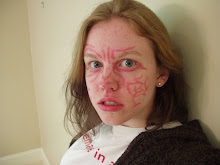
If you leave comments, don’t forget to say that I look awesome in this picture!